Tuesday, May 25, 2010

"Separate, Not Segregated"


In class, we talked about the a Arizona law that wants to cut classes that focus on the history of minorities in America.  The Bordentown School in New Jersey was reminiscent of the minority classes that Arizona wants to outlaw.  From 1886 to 1955, the Bordentown School was exclusive to African American students.  The school was all African American (students and teachers) by choice, not by the segregation laws in place at the time.  The New York Times says: 


"The school was founded by a black minister, who wanted to create educational opportunities for youths as more and more blacks came north to escape the lack of economic possibility and murderous racism of the South."  


However the school did have a downside; the article goes on to say that the school primarily taught its students jobs like how to be a chauffeur of a maid, etc.  With that being said, one must take into consideration that during the time this school was open it was very unlikely that a person of a minority group would be doing any other type of jobs.  


It seems to me that this law in Arizona is a regression in America today.  If a school over 50 years ago could be solely dedicated to educating a minority, why can't these schools in Arizona have just a class dedicated to a minority's history?

Is the movie industry getting a little too "Carried Away"?

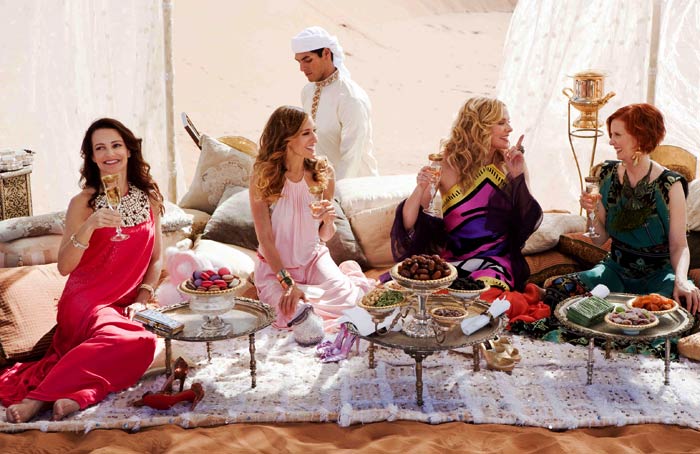
The long awaited Sex and the City 2 is set to hit theaters this Thursday.  It's hard to imagine someone who isn't familiar with the famed series, but for those who don't I'll give you a quick overview.  Sex and the City was a risque HBO series that aired from 1998 to 2004.  A movie continuation of the series was released on 2008 and its sequel will be released this Thursday.  The show is about the glamourous lives of four single women in New York City:  Carrie Bradshaw (the narrator of the show), Samantha Jones, Charlotte York and Miranda Hobbes.  SATC is famous for its scandalous plots and the four ladies' impeccable ,sometimes over the top, fashion statements. 


As you can tell from the picture, all four of the show's main characters are white.  Even the majority of the main character's love interests are white males, with the exception of Charlotte's husband who is jewish; but that's the only consistently diverse character.  The first SATC movie in 2008, cast Jennifer Hudson, who is an African American actress, to play Carrie's assistant.  She is a literal "side-kick",  clearly fitting the mold for a token character.  Is it right that such an iconic show is laking so much in diversity?   Would the series be as iconic if Carrie Bradshaw had been a minority?


Additionally, the latest motion picture boasts a 10 million dollar budget- for wardrobe alone, according to the Boston Globe.  The four ladies also take an overly luxurious trip to Abu Dhabi; not at all frugal for the producers.  Director Michael Patrick King says: "I thought Hollywood should take people on a big vacation...it was our job to give everyone the vacation that maybe they can’t afford now."  But during this economic crisis, is it irresponsible to have such a ridiculously high budget for fashion alone?

Monday, May 24, 2010

Racism in Medicine

I recently came across a really interesting Newsweek article.  It tells the story of Dr. Mana Kasongo (pictured on the left) and her journey as a doctor and the racism that exists in her field.  It was surprising to read that Dr. Kasongo had been not taken seriously throughout her career for being African American.  She says even some of her African American patients are confused upon hearing that she is an M.D. and not a nurse.  


Dr. Kasongo tells about a time when she used her skills as a doctor to help her friend:


I was having dinner at an upscale hotel in Las Vegas with a friend, when she started choking on a piece of food. As she flailed her arms in obvious distress, frantic cries of "Is there a doctor in the room?" rang out from nearby tables. I assured everyone that I was a doctor and administered the Heimlich maneuver successfully. Even as my friend regained her bearings, people at the surrounding tables kept screaming for a physician. Once the "real doctors"--two white males--came to the table and saw that her airway was clear, they told the staff that it appeared that I was in fact a doctor and that my friend was going to be fine."


This story shocked me.  It is clear that racism still exists in America today, but I did not realize that it was still so strong.  Even African American patients do not believe that there can be an African American doctor.  


What are your reactions to Dr. Kasongo's story?  What does this story say about America's progression? 

Wednesday, April 21, 2010

Interviews!!

So I actually ended up contacting two people for possible interviews.  Each responded in the same day and I plan to e-mail one and call the other this week!  My interview via e-mail is with Nicole Wise, the co-author of a book that I am using in my research.  The other is Lenore Skenazy, a New Trier grad.  She writes a blog called Free Range Kids and also has a book with that same title.  She is also a mother who raises her child as an anti-hyper parent. 

I am really excited to talk to both of theses women, and I am really surprised that they responded to me so quickly!  I'm also a little nervous, I still need to plan out my interview questions and I'm not really sure what to ask yet!

Tuesday, April 20, 2010

Junior Theme Research and Interview

As I continue my research, I am finding lots of really great articles focused on over-scheduled children in relation to college admittance and resume building, but I am really having a difficult time finding more information, other than resume building, as to why parents schedule their children so heavily. My research is producing the same types of articles and I need to find a way to create more variation in my research.

I am also working on contacting people for possible interviews.  So far, I found an author named Nicole Wise who co wrote a book I am looking at and who has written many articles for various newspapers concerning parenting and family issues.  Other than that, I am still not really sure who would be good to contact.

Monday, April 12, 2010

Junior Theme

Over the past week my class has spent in the library, I have finally managed to narrow down my topic for this year's junior theme paper.  My original topic was parenting styles and how they have changed over time in America.  After some basic research about different types of parenting styles, I was able to narrow down the broad topics of parenting to my final "why" question. 

Why do parents feel that they must control and micromanage every aspect of their childrens' lives?

There are a lot of articles out there about this topic, but I'm having trouble deciding which ones are 'scholoarly" enough to be used as research in my paper. 

Friday, March 19, 2010

Pepsi Publicity Stunt?

Pepsi is planning to remove all of their full calorie sugary drinks in primary schools in over 200 countries by the year 2012, according to CBS News.  The company is trying to promote healthy choices in children by only providing water, low fat milk and sugar free juices. 

But is this just a publicity stunt?

Pepsi's new plan reminded me of Monsanto's sponsorship of PBS.  Monsanto was just trying to create positive connotation with their name, is Pepsi trying to do the same by encouraging children to have a healthier diet?  By removing some of their drinks, is Pepsi actually trying to promote healthy choices or are they just trying to advertise? 

Thursday, March 18, 2010

New Mural to go up in Times Square

Images can be found here of a new mural to be unveiled near Times Square at the end of this April.  The mural painted by Sofia Maldonado is a depiction of African-American and Hispanic women in New York.  The mural is a rather gritty depiction of these women and it seems that many people find this piece of art to controversial to be displayed in a area with as much traffic as Times Square.  This statement was made in a release by the protesters:  "not one business or professional woman is represented in the mural for balance."  This is what is bothering them, along with the fact the African-American women are "depicted in a negative light"  and shows them as "cheap looking."

Take a look at some of the images.  How do you feel about them?  The protesters are arguing that a mural of a more high class woman in a buisness suit would be more appropriate.  What do you think?

Why We Must Fire Bad Teachers

This newsweek article titled Why We Must Fire Bad Teachers argues that the teacher in a classroom is more important than the curriculum and textbooks. So it would make sense to hire more good teachers and just fire the bad ones. However, the reality of this situation is not that simple.
In many places, teachers are given lifetime tenure after just a few years of working at a school and it is nearly impossible to fire them. In the United States, almost no teachers are fired for bad performance depsite the fact that many teachers are under performing. It seems that all the worst teachers are concentrated in the poorest and lowest class regions in the United States, and nothing can be done to get the bad teachers out and the good ones in. There are programs such as KIPP (Knowledge Is Power Program) set in place in poorer areas that are trying to better educate students despite the bad public school system, but these students are still at a huge disadvantage. 

What can be done to get better teachers into lower class school sytems?  Is it even possible to do this or are these school system just a lost cause?

Tuesday, March 16, 2010

Black Children are an "Endangered Species"


Recently a series of billboards like the one above have been put up in Georgia to promote an anti-abortion campaign.  More information can be found from this article.  

This ad certainly grabs one's attention, but many feel that it is an absolutely inappropriate to target the African-American community in this way.

How do you feel about this ad?  Is it fair to target a certain group like this ad does?

Laws of Power

In this CNN article, the author tells the reader about book called The 48 Laws of Power.  Its title pretty much sums up the book.   It's written by Robert Greene and is a list of 48 laws, that if followed, will give a person power.  Greene supports each law based on the lives of powerful historical figures.  It  is clear that humans are obsessed with power, and many people lives their lives as one huge power struggle.  Greene and many of his readers claim that these laws actually work and will help a person gain power.

But can just a list give someone power?  In class we heard a man named Phipps say: "that's the tribal belief, that you either have it (high class) or you don't."  You are born a WASP, you cannot become one he argues. Can the same thing be said about power?

Monday, March 15, 2010

The Decline of Status Markers

An article titled When the Joneses Wear Jeans:  Status Markers in the United States of America, explored the decline of "status markers" (a way in which one can determine another's social class by outer appearances).

Unlike the past, it is becoming harder to determine the social class of a person just by seeing their clothing or their car.  It seems that the range of people who own handbags or jeans or cars with designer labels splashed across them is becoming wider and wider.  People in the middle class have flat screen televisions, luxury cars, high end jewelry and jeans that cost $200 a pair, all of these items were once associated only to people of the upper class.  According to this article, %81 percent of Americans feel social pressure to buy high priced goods.   

The author of this article sates : "Social class, once so easily assessed by the car in the driveway or the purse on the arm, has become harder to see in the things Americans buy. Rising incomes, flattening prices and easily available credit have given so many Americans access to such a wide array of high-end goods that traditional markers of status have lost much of their meaning."  Although status markers may have lost their meaning, there are of course still differences between the lifestyles of the classes.  The article states that although higher end goods may be available to different classes, that personal services (chefs, maids, chauffeurs etc.) is the real difference between classes.

Are there any other ways that we can determine a person's social class other than their appearance?  If today the classes seem to blending together in outer appearances, how will the differences in social class continue to change?

In class we have been discussing the change of advertising in America's history.  Generally, higher priced brands have been targeted at the upper class.  If the middle class is catching up to the upper class in their material possessions, how might the advertising of higher priced goods change?

Class Differences in Marriage


In the New York Times Class Matters series that we looked at in class (the graph that tells you what class you fall into) I found an interesting article that discussed the marriage of two people from different social classes.  Both of these people had been marries once before and had two children, but the woman came from a very wealthy background and had received a good education whereas the man was not wealthy and had only made it through high school.  Although this article is specific to this certain couple's relationship, it is quite interesting to look at.  

The article says "In cross-class marriages, one partner will usually have more money, more options and, almost inevitably, more power in the relationship." Traditionally, husbands have the most power in a marriage but money and education seem to automatically switch the roles. Social class, as we have discussed in class, seem to have more power than a person's gender or race.  After the quote above, the article stated: "While most of those marriages used to involve men marrying women with less education, studies have found, lately that pattern has flipped, so that by 2000, the majority involved women...marrying men with less schooling - the combination most likely to end in divorce."  So, it seems that women with more money and education, and therefore more power, seems to cause more trouble in a relationship than when the man holds more power.

So, what has a greater effect on the power holder in a relationship?  Gender or social class?  Why is it that more marriages fail when the woman is of a higher social class?


Sunday, January 10, 2010

The Runaway Bunny


As a child, my favorite storybook was The Runaway Bunny.  The story begins:

Once there was a little bunny who wanted to run away.
So he said to his mother, “I am running away.”
“If you run away,” said his mother, “I will run after you.
For you are my little bunny.”

The bunny then comes up with various scenarios where he transforms into other animals, trying to escape his mother.  The mother in turn thinks of a way to catch her little bunny.  For instance:

“If you run after me,” said the little bunny,
“I will become a fish in a trout stream 
and I will swim away from you.”

“If you become a fish in a trout stream,” said his mother,
“I will become a fisherman and I will fish for you.”

And so on.  The book ends with:

“Shucks,” said the bunny, “I might just as well
stay where I am and be your little bunny.”

And so he did.
“Have a carrot,” said the mother bunny.

The mother will do anything to keep her little bunny safe and close to home.  But is this truly for her child's benefit, or is it for her own?  It seems to be that young children are ready to become independent long before their parents are ready to let go.  This story is a depiction of a mother who is always there for her child.  But the little bunny in this story is forced to come back home, he gives up on running away because he knows he can never escape his mother.  Is this story teaching kids that mother is always there, ready to catch you?  Is it best for a parent to always be searching for their child?

Toxic Parents


In class, a "sucky parent" has been brought up more than once.  A New York Times article describes those kinds of parents as "toxic."  We hear all sorts of stories about bad parents, parents who physically abuse their children, parents who neglect their children and some who emotionally abuse.  Although some toxic parents  leave don't actually physically abuse their children, I think that we can all agree that any sort of neglect can be considered 'toxic.'  In the movie Matilda, the young heroine's parents are more concerned with their lives rather than the well being of their child.  In the end of this film, Matilda (the protagonist) discovers that she has magical superpowers and ends up being adopted by her grade school teacher who was also victim to a toxic guardian.  However this is only a story, and as we know children who have sucky parents usually don't have such a happy ending.  The article bring to light that in almost any other abusive relationship, there is a way out for the victim.  However, a child cannot escape their parents.  Few children are able to break the cycle of toxicity.  How do you think a child can escape a toxic parent?  Can they do it on their own, without any magical powers?

What "I love you" really means from mom and dad


I came across an interesting article entitled When a Parent’s ‘I Love You’ Means ‘Do as I Say’. This article described a parenting disciplinary tactic called "conditional parenting."  In this tactic, parents show love and affection to their children only when they are good and only when they earn it.  As a form of punishment, they withhold affection.  This type of parenting is advised by parenting figures like Dr. Phil and Supernanny, and it is a tactic that is shown to be somewhat affective.  Generally, children who are disciplined in this way act like they're parents want them to.  However, these children tend to be more resentful of their parents and also feel more pressure from their parents.  This article quotes "Supernanny's" parenting book which says: “the best rewards are attention, praise and love,” and these should be held back “when the child behaves badly until she says she is sorry,” at which point the love is turned back on."  The love between a parent has for a child is supposed to be unconditional, is it right for parents to use love and affection as a tool to get their child to act a certain way?

Thursday, January 7, 2010

Freedom to Wander


Overprotective parents have prevented their children from exploring life in a way that was once common. In Huckleberry Finn's world, he and his comrades have the freedom to wander and have "adventures."  Although the other children in Twain's novel did not have as much freedom as Huck, they were still able to go out all day and play without having to worry about reporting in to thier parents.  Technology has certainly changed the ability for a child to wander.  Almost everyone has a cell phone and chilren are electronically wired and attached to their parents at all times.  Also, more high school graduates than ever are applying to colleges, and parents are holding their kids down with school pressure.  Children are no longer playing robber and pirate games or running around the neighborhood.  They are being sheltered and are being subject to rigourous school work at an earlier age than ever before.  Parents are keepping a closer eye on their kids and an imaginary line seems to attach children to parents when the kids are playing.


How far were you allowed to "wander" as a child?  Do you think this has changed between you and your other siblings?  Why are kids so sheltered today?

Wednesday, January 6, 2010

Siblings growing up in "different families?"


A very typical belief today is that the order of your birth can cause you to have a certain personality type.  The oldest is the hardworking over achiever, the middle is always trying and catch up to their older sibling, and the youngest is outgoing.  A New York Times article discusses this and also the family experience that each child in a family goes through.  The author discusses that birth order doesn't really effect a child in the way we usually think it does an that a specific kind of personality cannot at all be assumed by the child's birth order.  One claim that the author made that I found very interesting was "children and parents alike are profoundly affected by the constellations of siblings; it is said that no two children grow up in the same family, because each sibling’s experience is so different."  So other siblings and parents past experience with their children effects how a child acts.


How does the birth order stereotype fit in with your family?  How do you think your siblings have effected your growth?  Do you think you have grown up in a "different family" then your other siblings?

"Boozy Grandmas"


I found an article form CNN that caught my eye.  The title was Boozy Grandmas, not exactly two words that are normally seen together.  The article was about how television shows, and even some movies, are using a grandmother who drinks to add some humor and drama to the show.  I feel a "boozy grandma" would attract people to watch a show, its so unexpected that many would find it humorous and intriguing to see and old woman in such a light.  

The article describes the hard-drinking grandmothers on television shows to be "wealthy, white and cruelly witty, with poor parenting skills."  The last description of a boozy grandma, a woman with "poor parenting skills",  is what really stuck with me.  Why would there be a correlation between bad parenting and a drinking grandmother?  I guess a better question to ask is, why do the people creating these characters believe that a grandmother who drinks is automatically a bad parent?  In addition to the boozy grandma, it is common to see an alcoholic father in television shows.  Why is it that we seldom see an alcoholic mother?

Tuesday, January 5, 2010

New Year's Resolutions and the Media

Take a moment to think about the kinds of television ads are common during this time of year.  Diet plans, gym memberships, low calorie meal packages, anti-aging treatments and deals on fitness equipment. Looking better and improving appearances is probably the most common resolution people have for the new year.  Companies realize this and are defiantly using this to their advantage.  


The desire to look good in the United States is more prevalent than ever and people feel immense pressure to live up to the standards of Hollywood and the media.  So right when people are making resolutions to improve themselves, the media pounces.  They attack the public with ads promising better bodies and younger appearances.  They are attacking consumers with low self esteems at a point where they desperately want to change.  Really, they are taking advantage of these people.  This is very similar to the clip from TheCorporation that we watched and discussed in class.  In class, we discussed whether or not it was fair to target children, who are still of course under-deveopled, in commercials.  


Is it fair to target adults around the new year? Are the ad companies taking advantage of them or exploiting them?  Is it fair to use people's weaknesses to sell a product?

Monday, January 4, 2010

Can a Criminal Change?

In a Newsweek article, Second Chances by Raphael Johnson, the author tells his story of arrests and murder during his teenage years. He stole a gun at 12 and was arrested, then sent to a boy's home at 14.  At 18, when he was supposed to head off to college, he killed a chaperone who threw him out of a party.  Despite the rough neighborhood he grew up in and his arrests and violence, Johnson excelled in school and earned scholarships to both high school and college.  He spent 12 years in prison, and during this time he still worked hard to become certified as a carpenter, plumber, electrician and paralegal.  After being released from prison, he ran a motivational speaking and fitness company.  Needless to say, Johnson is very successful and has come a long way since his teenage years.


Clearly, Johnson made a huge mistake as a child that caused a man his life.  However, Johnson has managed to pull his life together because he was given a second chance and was released from jail for a crime that would usually cost someone a life sentence.  Saying this, there are also many teenagers who commit crimes and fail to redeem themselves later in their life.  So, can a criminal change, should criminals be given a second chance?  Or is it too risky?

"The kids were what we had in common.."


Having moved around a lot when I was really young, one would think that I never got a chance to experience the very American tradition of a close-knit neighborhood.  However, every place that I lived, all very different in location and size, I feel I did fully experience the American tradition of a 'neighborhood'.  I remember all sorts of neighborhood children and their parents and babysitters.  The memories and adventures I had with the kids on my block are ones I know I will remember for the rest of my life.  But this got me wondering what the experience may have been like for my parents.

 I found an article about the relationships on the street where one man lived with his family for many years.  When talking about the fading relationships he was experiencing with the adults on his street, he said "Looking back, the kids were what we had in common, and now we don’t. "  Maybe this is because I'm still a child myself, but I really cannot cannot think of a worse thought.  When we grow older and have children, is that what our lives will become?  Will our relationships with other adults be held together only by our children?  


FBI Violates Privacy

I find it frightening when an organization as powerful as the FBI starts to violate civil liberties.  As we discussed in the Minority Report thoughtcrime blog, no good can come of the government violating civil liberties.  I found an article from The New York Times that reveals such an instant where the FBI has violated the right to privacy and has also discriminated against people to weed out potential suspects that may, or may not, pose a national threat. 


In response to a suicide bombing in Africa by a Somalian in 2008, the FBI began to suspect people of terrorist attack based solely on ethnicity or religion rather than actual evidence.  In fact, for most cases, they had no evidence to support their accusations other than the persons ethnicity. The FBI would collect personal, and private, information about these 'suspects' without even having evidence that they had done anything wrong.  Not only are theses investigators discriminating certain ethnicity and religions, but they are digging into their private lives with no evidence to support that they are guilty at all.  The FBI has said that they have some other reasons to believe that these people pose a threat, but we of course can never really know how much evidence they have.  Is it at all justifiable for the FBI to investigate these 'suspects' almost solely on religion and ethnicity?  Is that enough?

Sunday, January 3, 2010

Miss California's Civil Liberties

Most of us are pretty familiar with the infamous Carrie Prejean incident.  If not, you can read a short summary here.  Miss Prejean claims that the reason she lost the crown during the Miss America pagent was beacuse she openly disagreed with gay marriage. She said in response to a question regarding gay marriage asked by a gay man,  "I think it's great Americans are able to choose one or the other. We live in a land where you can choose same-sex marriage or opposite marriage . . . I believe that a marriage should be between a man and a woman. No offense." Miss Prejean could have said her statement in a more intelligent way, but her point, which is completely valid, still comes across.

She of course was not taken to court or severely punished for her statement, but nonetheless she was still scrutinized for it.  The statment she was made against gay marriage was not only unexpected from the mouth of a young beauty queen, but some felt it was also unethical. I read an interesting ariticle that discusses Miss California's ordeal. This author says that Prejean's claim that her right to free speech was violated is completely ridiculous.  He points out that, although she did take some heat for her words, that others were simply exerting their right to free speech.  Their argument was just disagreed with Prejean.  Was her right to free speech violated when she was stripped of the crown?  Perhaps if she had more eloquently stated her belief, would the public have had less of a reaction to her statement?